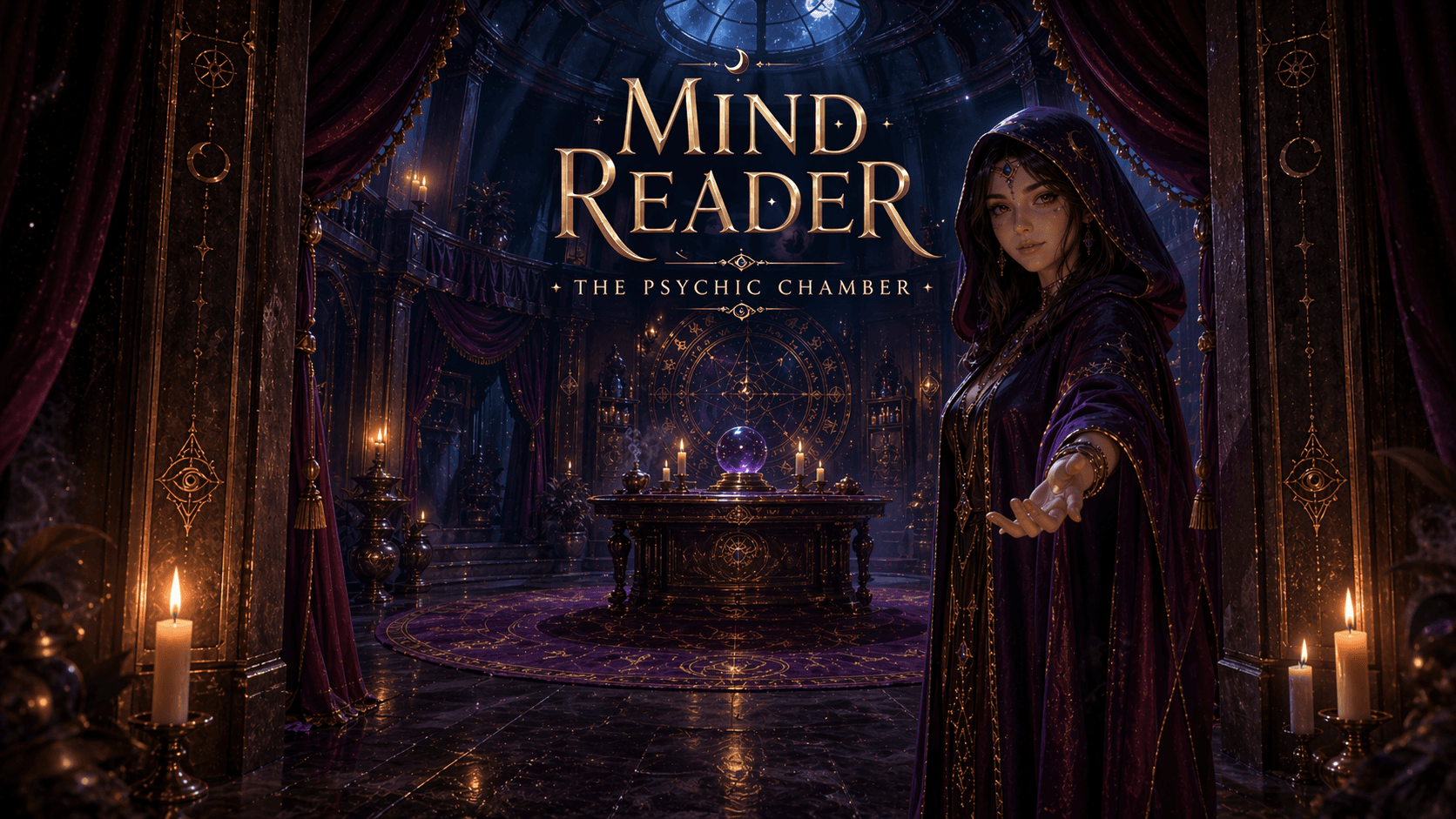
The chamber is listening

Mind Reader

Enter Mora's psychic chamber and choose which mind will be read.

Enter the chamber

Inside the Psychic Chamber

A polished game world, explained like a real public site.

These sections explain the rules, systems, privacy model, and content scope behind Mind Reader without crowding the cinematic entry scene.

What Mind Reader is

A cinematic guessing game hosted inside Mora's psychic chamber.

Mind Reader is a public browser game that turns a classic twenty-questions-style guessing loop into a theatrical mind-reading ritual. Instead of navigating a dashboard, visitors step into Mora's chamber and play through dialogue, clues, and reveals.

The game currently supports two mirrored rituals, personal local memory, deterministic scoring, public-rank-ready services, and a curated entity catalog built for repeated play.

Read My Mind

Mora asks the questions and tries to uncover your hidden thought.

In Read My Mind, you choose a category and silently think of something. Mora begins with broad questions, then moves through category, profile, specialist, and fine-detail clues as the evidence narrows.

Your answers are not treated as brittle eliminations. Yes, no, probably, probably not, and unknown are converted into weighted evidence so uncertain answers remain playable.

Guess My Mind

You question Mora and decide when you are ready to guess.

In Guess My Mind, Mora hides a thought and you investigate it through a guided clue browser. The interface shows only a small set of recommended questions at a time so the mode feels strategic rather than overwhelming.

Players can stay in a question family, go broader, move deeper, switch inquiry paths, or make a final guess when the pattern feels strong enough.

Scoring and fairness

The score rewards skill without encouraging random clicking.

Read My Mind rewards endurance, difficulty, consistent answers, and fairly stumping Mora. Guess My Mind rewards correct solves, fewer wasted questions, fewer failed guesses, and harder difficulty settings.

Mora is allowed to refuse a guess when the vision is too divided. That keeps the game trustworthy: fewer reckless wrong answers, clearer teach-flow moments, and better long-term learning.

Privacy and profiles

Player identity is lightweight, anonymous, and local-first.

The first-time name gate creates a display name and stable player id without requiring email, passwords, or a traditional account. Chamber Memory keeps profile, history, scores, and teachings available between visits.

Public ranking can use a display name and aggregate score totals, but private answer text, hidden entity names, teach notes, and free-text player content are not sent through analytics by default.

How Mora's inference works

The chamber uses layered questions and calibrated probability.

Mora ranks candidates with a smoothed evidence model so sparse profiles do not collapse to impossible and weak answers do not overpower strong ones. The system also tracks recent question families to avoid monotony.

Late in a round, question selection shifts toward specialist and fine discriminators that separate the leading candidates rather than repeating broad questions that no longer help.

Categories and content size

The active catalog spans five playable domains.

Mind Reader currently includes fictional characters, animals, objects, foods, and historical figures. The seed bank contains thousands of records, while quarantine tooling keeps weak, misplaced, or non-playable seeds out of active gameplay until repaired.

Content quality tools report duplicate aliases, weak profiles, question-family balance, profile-similarity clusters, and accuracy diagnostics so future expansions can improve Mora's guesses instead of merely increasing bulk.